A recently circulated video on social media has reignited online speculation surrounding the 2007 disappearance of Madeleine McCann, after users began comparing archival footage of an unidentified woman seen leading a young girl with images of Ghislaine Maxwell. The side-by-side comparisons, widely shared across platforms, have prompted renewed discussion — though law enforcement authorities have never confirmed any connection between Maxwell and the McCann case.
Madeleine McCann was three years old when she disappeared from a holiday apartment in Praia da Luz, Portugal, on May 3, 2007. Her disappearance became one of the most internationally recognized missing-child investigations in modern history. Portuguese police, assisted by British authorities, conducted extensive searches and investigations over the years. Despite multiple leads and persons of interest, no definitive resolution has been reached.
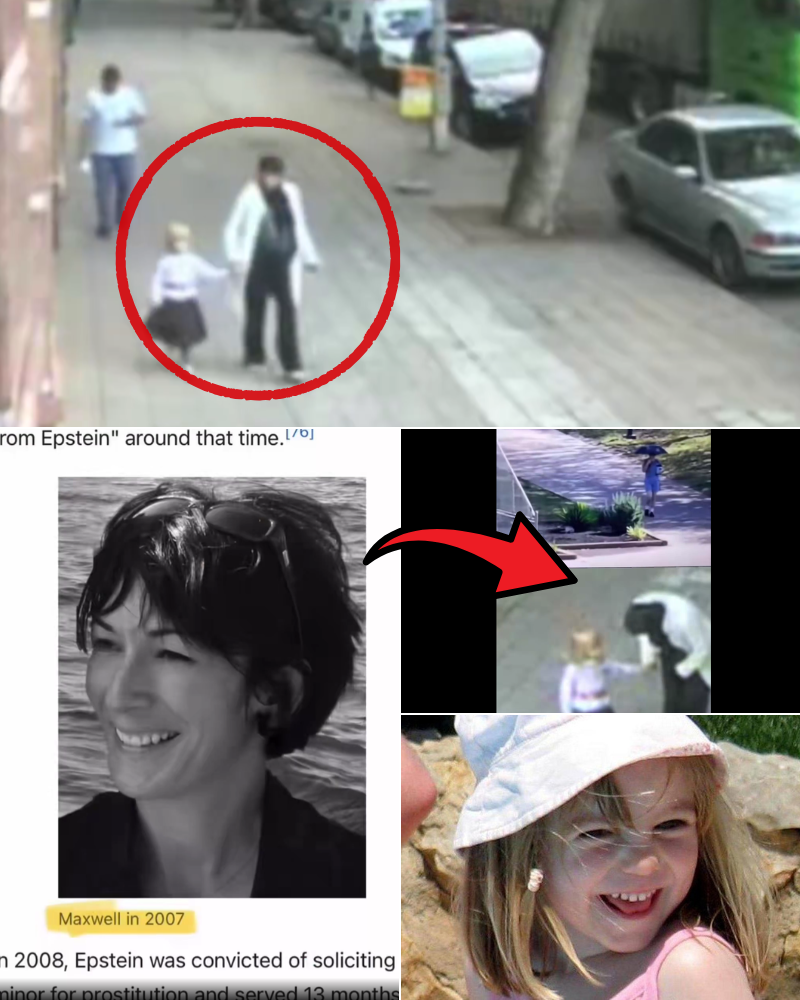
The current viral video centers on previously released footage showing an unidentified woman walking with a child on the night Madeleine vanished. At the time, investigators appealed to the public to help identify individuals seen in the area, including a man later known as the “Tannerman” sighting, as well as other possible witnesses captured in surveillance or reconstructed imagery. Over time, several early persons of interest were ruled out or clarified as unrelated tourists.
The new wave of speculation stems from online users suggesting that facial structure and posture similarities between Maxwell and the woman in question warrant scrutiny. However, digital forensic experts caution that such visual comparisons — particularly those based on low-resolution, grainy, or distance-captured footage — are highly unreliable. Image distortion, lighting conditions, frame rate limitations, and compression artifacts can significantly alter perceived facial proportions and body shape.
Ghislaine Maxwell was convicted in 2021 in the United States on federal charges related to sex trafficking in connection with Jeffrey Epstein. Her conviction involved crimes committed primarily in the 1990s and early 2000s. There has been no public statement from U.S. or European authorities linking her to the disappearance of Madeleine McCann.
Madeleine McCann remains the subject of an ongoing investigation led by German prosecutors, who in recent years identified Christian Brueckner as a prime suspect. German authorities have publicly stated they believe Madeleine is deceased, though no body has been recovered and no charges directly related to her death have resulted in conviction to date.
Investigative agencies typically rely on forensic evidence, telecommunications data, travel records, witness testimony, and verified timelines — not visual resemblance alone — when establishing connections between suspects and criminal events. Law enforcement officials have not reopened or modified their investigative direction in response to the viral video.
Media analysts note that high-profile cases often attract renewed attention whenever individuals connected to other notorious crimes reenter public discussion. The blending of separate cases into speculative narratives is common in the age of social media, particularly when both involve themes of child exploitation and international networks.
Digital misinformation specialists warn that viral side-by-side comparison videos can create powerful psychological impressions even when no evidentiary basis exists. Human perception is highly susceptible to pattern recognition bias — the tendency to see meaningful connections between unrelated stimuli. In cases involving emotionally charged subject matter, that bias can be amplified.
Authorities in Portugal, the United Kingdom, and Germany have not issued statements addressing the Maxwell comparison directly. Law enforcement agencies generally avoid commenting on unsubstantiated online theories unless they interfere with active investigative efforts.
The McCann case has undergone numerous investigative phases over the past 17 years, including Portuguese criminal inquiries, British Metropolitan Police review operations, and German prosecutorial involvement. Each phase has centered on documented evidence and witness corroboration.
Maxwell’s documented movements in 2007 have not been publicly tied to Portugal in connection with the McCann investigation. No official travel records or prosecutorial filings have indicated her presence in Praia da Luz during the timeframe of Madeleine’s disappearance.
Legal experts emphasize that suggesting involvement in a crime without evidence can carry serious reputational and legal implications. Courts require demonstrable proof — not resemblance or circumstantial visual similarity — to establish criminal responsibility.
The resurgence of speculation highlights the enduring global attention surrounding Madeleine McCann’s case. For many observers, unresolved mysteries invite continuous reexamination. However, investigative authorities maintain that official leads are pursued through structured legal processes rather than public conjecture.
As of now, there is no verified evidence linking Ghislaine Maxwell to Madeleine McCann’s disappearance. The viral comparison remains an online theory unsupported by law enforcement findings.
Investigators continue to focus on established suspects and forensic leads in the McCann case. Officials urge the public to rely on confirmed information from credible sources and caution against amplifying unverified claims.
The case remains open. The speculation, however, remains separate from the official investigation.