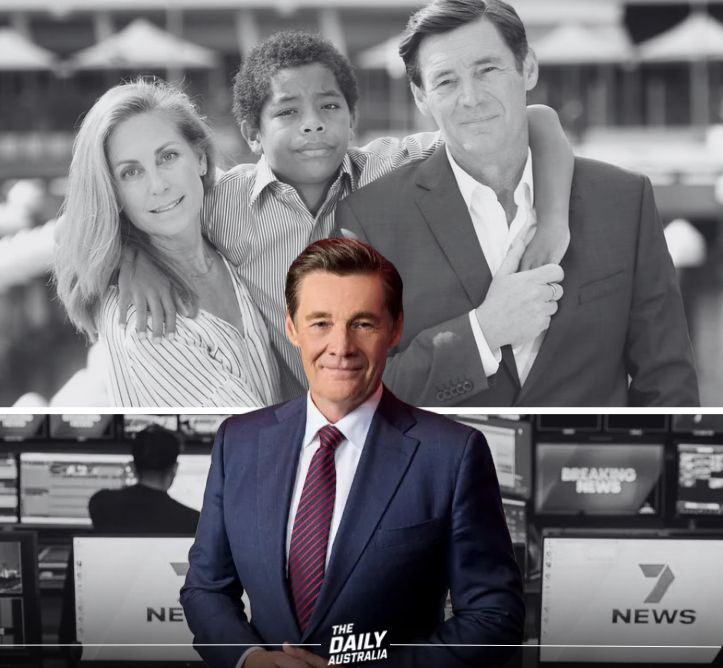
For years, Mike Amor was the familiar face Australians welcomed into their homes each evening. As one of Seven’s best-known newsreaders and a former foreign correspondent, he had reported on some of the world’s most devastating events.
But in early 2018, the veteran journalist found himself facing a frightening crisis of his own — one that threatened something he had never imagined losing: his eyesight.
Viewers may remember the period when Mike appeared on television with unusually red, irritated eyes. His eyes were constantly watering, and he struggled to read the autocue. Online, cruel memes suggested he was presenting while under the influence of drugs.
What viewers did not know was that behind those unsettling images, Mike was fighting a serious eye condition. The pressure inside both eyes had reached dangerously high levels, and doctors warned that he could lose his sight entirely.
Years later, Mike has spoken candidly about the experience, revealing the terrifying medical procedures, the emotional toll on his family and the moment he broke down in front of his wife, Tracy, fearing he might never be able to watch his young son grow up.
A Routine Eye Appointment That Revealed Something Unexpected
Mike’s health battle began when he was in his mid-20s.
At the time, he visited an optometrist in country Victoria for what he thought would be a routine appointment to get reading glasses. Instead, the examination uncovered something unusual.
The optometrist noticed a distinctive pattern of pigment deposits in his eye, known as a Krukenberg spindle, associated with a condition called pigment dispersion syndrome.
Mike recalled how the discovery caused quite a stir in the practice. The optometrist even invited other staff members to come and examine his eyes, explaining that he had previously seen the finding only in textbooks.
As Mike later described it, the pigment looked almost like pepper scattered inside the eye.
The concern was that these pigment particles could accumulate in the eye’s drainage system, obstructing the normal flow of fluid and causing pressure to rise. Over time, dangerously elevated pressure can damage the optic nerve and lead to permanent vision loss.
Thankfully, Mike’s eye pressure was normal at the time. He began monitoring the condition, and for several years, it appeared manageable.
However, that early discovery would become crucial to the fight that lay ahead.

When The Treatment Stopped Working
As Mike entered his 40s, doctors introduced laser treatment known as Selective Laser Trabeculoplasty (SLT) to help control the pressure in his eyes.
For several years, the procedure appeared to work.
Then, in 2017, its effectiveness began to diminish. His eye pressure started climbing beyond 20 mmHg, and his treatment became increasingly complicated.
He was prescribed more and more medication. What began with one type of eye drop eventually became four different drops, some requiring repeated applications throughout the day.
He was also given acetazolamide, an oral medication commonly used in certain situations to reduce eye pressure, but the side effects were extremely unpleasant.
Despite the growing treatment regime, his eye pressure continued to rise.
At the same time, Mike was working an extraordinarily demanding schedule as Seven’s US correspondent. Based in America, he travelled for much of the year, often working 12-hour days and crossing time zones to cover major international events.
Keeping medical appointments was not always easy. On occasions, he had to choose between seeing his ophthalmologist and travelling to cover breaking news, including earthquakes and mass-casualty events.
Looking back, Mike acknowledged that his demanding career had made it difficult to put his health first.
He later explained that he had become far more disciplined about medical appointments, making it clear that work would no longer come before his eye health.
The Return To Melbourne That Became A Medical Emergency
The crisis reached its most frightening point in early 2018.
Channel Seven offered Mike the opportunity to return temporarily from the United States to Melbourne and trial as a newsreader on the 6pm bulletin over the summer period.
It should have been an exciting professional opportunity.
But as he prepared to appear on Australian television, his eyes began turning an alarming shade of red. They became sore, irritated, constantly watery and extremely sensitive.
At first, the problem was mistaken for an infection. Mike later discovered that he had actually developed an allergic reaction to one of his prescribed eye drops.
The condition became increasingly difficult to conceal on camera.
He recalled having to wipe away tears between introductions and struggling to see the autocue clearly.
Mike even joked that he looked like a character from The Walking Dead.
But behind the humour was a deeply uncomfortable reality. While he was trying to do his job in front of millions of viewers, his eye pressure was reaching dangerous levels.
The online reaction made an already difficult period even worse. Memes circulated suggesting he was smoking marijuana or presenting while high.
What audiences did not realise was that Mike was dealing with a potentially sight-threatening medical emergency.
The Number That Changed Everything: 58
Concerned by what she was seeing, Mike’s wife, Tracy, knew he needed more specialised medical attention.
When she returned to America ahead of him, she began urgently contacting specialists to find someone who could assess his condition.
She eventually secured an appointment with Dr Vic Chopra at the Doheny Eye Institute in Los Angeles.
When Mike was examined, the results were alarming.
Despite taking multiple medications, the pressure in both of his eyes had climbed into the high 50s, reaching approximately 58 mmHg.
For context, the level considered within the normal range is generally around 10–21 mmHg, although individual treatment targets vary.
The specialist warned that his eyes could suffer a devastating complication at any moment, potentially leaving him blind.
Mike later described the situation in terrifyingly simple terms: he was petrified.
There was no room for further delays. Surgery was urgently required, and Dr Chopra rearranged the operating schedule to accommodate him within days.
It was no longer simply about managing a chronic condition. It had become a race to protect his remaining sight.

A Series Of Surgeries — And A Fear He Could Barely Put Into Words
Mike’s initial operations did not deliver the results everyone had hoped for.
He first underwent trabectome surgery in his left eye, followed by the same procedure in his right eye two weeks later. Both attempts failed to bring the pressure under control.
Doctors then moved to trabeculectomy, a more invasive operation designed to create a new drainage pathway for fluid inside the eye.
The procedure was successful in his left eye, but almost too successful. His pressure dropped dramatically, from the high 50s to just four, causing folds on the eye’s surface and leaving him struggling to see.
The operation on his right eye failed.
His condition remained so difficult that Dr Chopra eventually attempted another procedure in the clinic, using a fine needle to reopen the drainage area in his right eye.
Mike described the experience as extremely uncomfortable and painful. Tracy watched in tears.
This time, however, the procedure worked.
Throughout the ordeal, Mike endured repeated treatments, lengthy hospital visits and periods of uncertainty. He became sensitive to light and, at one stage, could only read with the help of a magnifying strip of plastic.
But perhaps the most painful part was the fear of what might happen if treatment failed.
Mike recalled breaking down in front of Tracy, terrified that he might lose his sight and be unable to watch their then nine-year-old son, Addison, grow up.
He was from a generation taught that men should not cry. Yet the possibility of losing something as precious as his vision, and the thought of missing the milestones of his little boy’s life, became too much to hold inside.
It was a deeply personal moment that revealed just how much was at stake.
The Woman Who Stood Beside Him Through It All
Throughout the ordeal, Tracy became Mike’s greatest source of support.
She drove him more than an hour each way to his medical appointments, often almost every day. The couple sometimes waited four, five or even six hours to see the specialist, only to receive another difficult update.
At the same time, Tracy was effectively raising Addison on her own while trying to navigate the frightening uncertainty surrounding her husband’s health.
Mike never underestimated what she had done for him.
“I couldn’t have done it without her,” he acknowledged.
His gratitude was more than a passing expression of affection. Tracy had been the person making calls, finding specialists, driving him to appointments and remaining beside him during procedures that had left both of them frightened.
Mike’s experience also exposed how stressful navigating the American healthcare system could be. He described the difficulty of securing urgent appointments, the long waits between consultations and the medical terminology that was often difficult for patients to understand.
He admitted that doctors’ explanations sometimes frightened him because he did not fully understand what the procedures involved.
For someone facing the possibility of blindness, the emotional burden could be just as overwhelming as the physical treatment.
Five Months Away From Work — And A Decision That Changed His Life
Mike remained away from work for five months while the bleeding in his eyes gradually cleared and his vision began to recover.
Then, in August 2018, he received an opportunity that would bring him back to Melbourne permanently.
Despite the difficulties surrounding his earlier trial, Seven offered him a weekend newsreading position.
It meant leaving behind his long-running life in America after 18 years as a foreign correspondent.
By his own admission, the health crisis had forced him to reconsider what really mattered.
While he was unable to work, he found himself doing things he had previously missed because of his relentless travel schedule.
He could attend Addison’s soccer training, pick him up from school and spend time with his family doing ordinary things.
Mike realised just how much of his son’s childhood he had been missing.
As he later reflected, that experience made the decision to return home and leave a job he had genuinely loved much easier.
It was an unexpected consequence of an experience he would never have chosen, but one that changed his perspective on family, work and the preciousness of everyday life.
The Fight Has Not Completely Ended
After returning to Australia, Mike continued treatment with Associate Professor Michael Coote at Melbourne Eye Specialists.
He underwent further operations to manage the pressure in his eyes, including treatment involving cataracts. By June 2026, Glaucoma Australia reported that he had undergone multiple glaucoma procedures as well as two cataract operations.
His condition was described as stable.
That does not mean the disease has disappeared. Mike continues to use prescribed eye drops twice daily and sees his ophthalmologist every six months to monitor his condition.
He also understands that further procedures may be necessary in the future.
But his outlook has changed.
Having endured multiple operations and the frightening possibility of losing his vision, Mike is now far more comfortable with the prospect of additional treatment if required.
In March 2024, he became an official ambassador for Glaucoma Australia, choosing to share his personal experience to help others recognise the importance of looking after their eyes.
He has spoken about how easily glaucoma can go unnoticed, particularly because people may not experience obvious symptoms even as the disease progresses.
The experience has given him a new appreciation for early detection, regular examinations and the support available to people living with the condition.
The Message Behind His Most Frightening Experience
Glaucoma is often called the “silent thief of sight” because it can gradually damage the optic nerve without obvious early warning signs. Once vision is lost through glaucoma, that damage cannot be reversed.
According to an Australian Prescriber clinical review published in October 2026, an estimated 300,000 to 380,000 Australians are living with the condition, with approximately half unaware they have it.
Mike knows how easily things could have turned out differently.
He had no family history of glaucoma and, despite his condition, did not experience obvious symptoms that would have alerted him to the danger when his eye pressure became critically high.
Had that first routine eye examination in his twenties not revealed the unusual pigment deposits, his condition might have progressed unnoticed for much longer.
Today, he wants his story to give others a reason to take their eye health seriously.
His journey has been filled with frightening diagnoses, failed procedures, painful operations and the overwhelming fear of losing his sight.
But it has also revealed the importance of family, the strength of a partner’s love and the value of a second chance.
For a man who spent years reporting on the tragedies and struggles of others, one of his most difficult battles unfolded far away from the news cameras.
And perhaps the most meaningful thing he took from it was not simply the ability to return to work, but the opportunity to go home, watch his son grow up and rediscover the everyday moments he had once taken for granted.
Mike’s condition may now be stable, but his reason for sharing the story remains as important as ever.
He knows how frightening the words glaucoma and possible blindness can be. Having lived through that fear himself, he wants others to know that early detection, appropriate treatment and ongoing care can make an enormous difference.
And after everything he endured, being able to see the people he loves is something he will never take for granted again.